
More life in your life.
Living well after 40 involves everyday choices and knowing which ones deserve your attention.
How to Choose a Whey Protein Powder After 40
A practical guide to protein types, ingredients, dietary needs, and value.
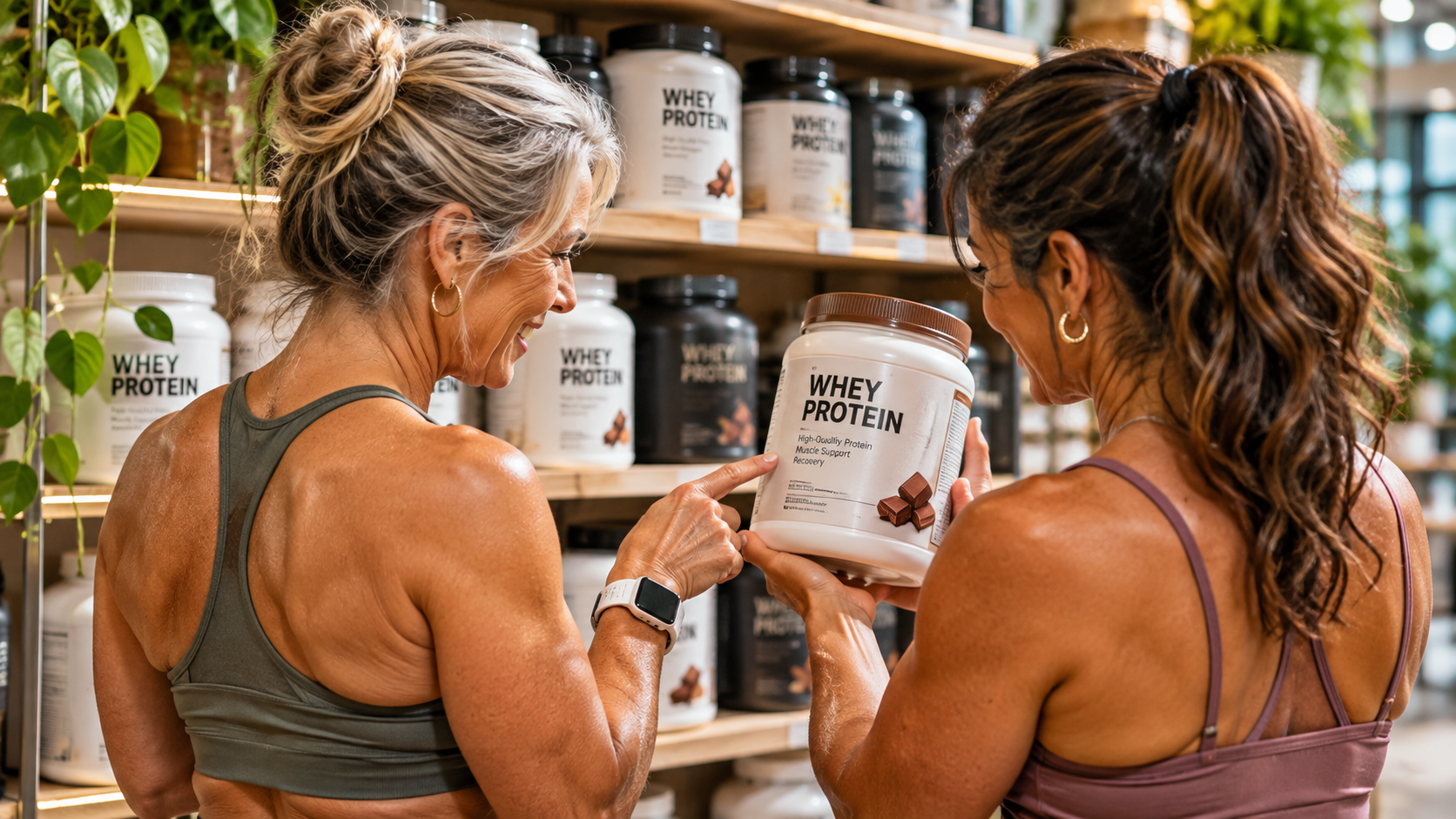
A practical guide to protein types, ingredients, dietary needs, and value.
Shopping for whey protein can feel like buying a car when all you wanted was a ride to the grocery store. There are premium models, technical terms, and plenty of promises.
Your goal may be much simpler: make breakfast more satisfying, add protein to a busy day, or support your strength-training routine.
Choosing well starts with understanding what you need. This guide will help you read the label, compare your options, and decide what deserves a place in your kitchen.
The quick answer
To choose a whey protein powder after 40, start with your usual meals and the role a supplement would play. Then compare the protein type, protein per serving, ingredients, dietary restrictions, independent certification, and cost for an equal amount of protein.
There is no special whey formula you automatically need at 40.
Age alone does not tell you which product to buy or how much to take.
Before choosing a brand, finish this sentence:
“I want to use whey protein to ______.”
“Add protein to my quick breakfast” is a useful answer. “Because the label says healthy aging” needs a little more investigation.
1. Start with your meals
Think about a few ordinary days. Where does your protein come from? Are you regularly eating foods such as beans, tofu, eggs, fish, poultry, or yogurt? Is there a meal you struggle to put together?
Harvard’s The Nutrition Source emphasizes that protein foods come with other nutrients, including different fats, fiber, and sodium. That wider nutritional picture matters—not just the protein number. [1]
A powder can be convenient, but it should have a clear job in your eating routine. You might compare adding whey to breakfast with choosing a protein-rich food you enjoy. Neither choice needs to become a lifestyle identity.
What does the research actually support? A 2018 review combining 49 studies found that protein supplementation added to improvements in muscle size and strength during resistance training in healthy adults. The research examined supplementation alongside training; it does not show that buying whey alone produces those results. It also does not identify a special formula for everyone over 40. [2]
If you have kidney disease or a prescribed protein restriction, ask your clinician or registered dietitian before adding a supplement. NIDDK, part of the National Institutes of Health, explains that protein needs in kidney disease require an individualized balance. [3]
2. Understand the main whey types
Whey is a milk-derived protein. It contains all nine essential amino acids—the amino acids your body needs to obtain from food. Harvard’s overview of workout supplements describes whey as one of the complete proteins found in milk. [4]
You will commonly see three terms:
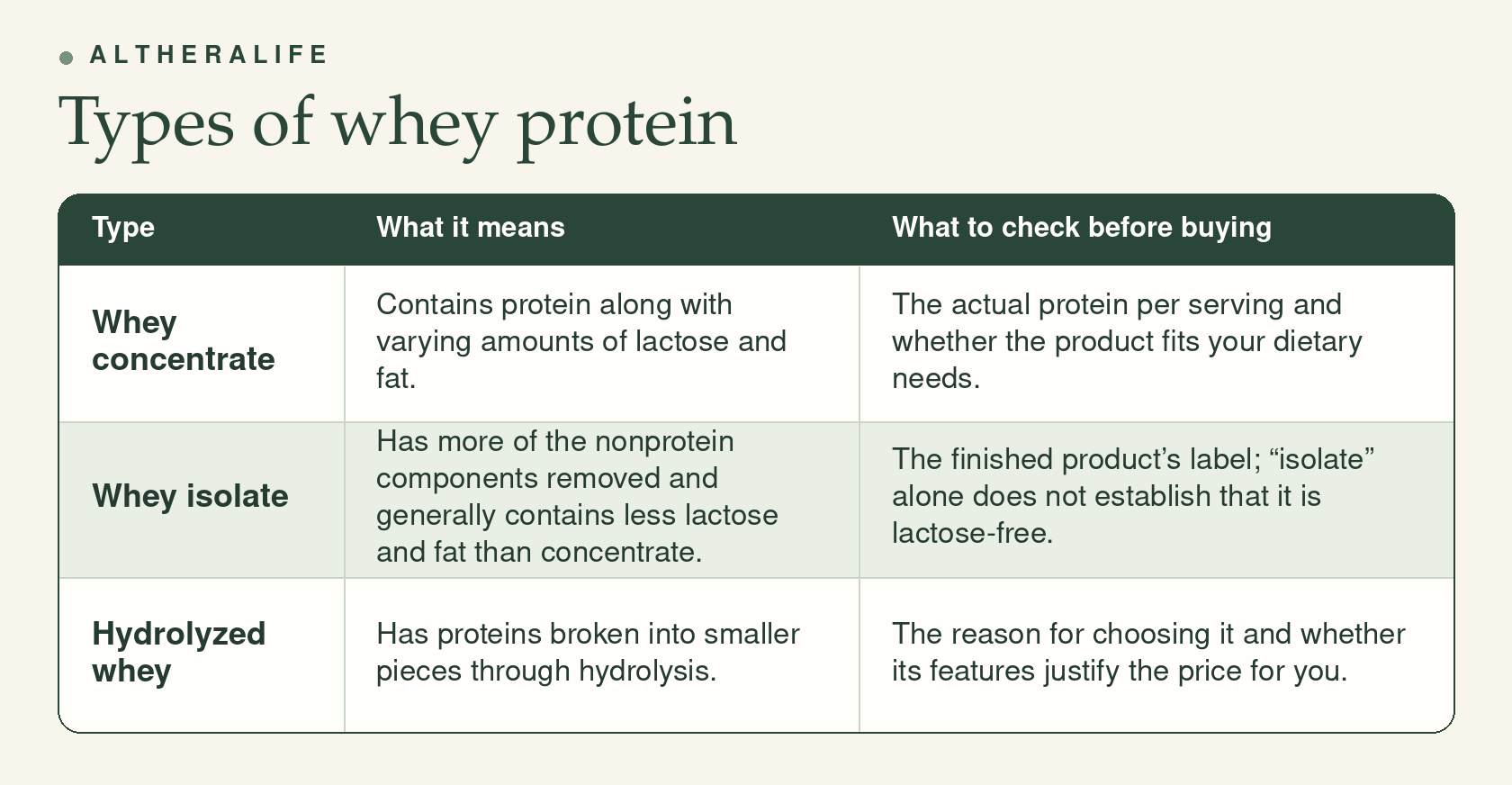
These processing differences are described in the scientific literature. They are ingredient categories, not a ranking of which finished product is best for you. [5]
Use the type as a starting point, then compare the full formula. A prominent “isolate” claim does not answer every question about the ingredients inside.
3. Read the label in this order
Turn the tub around. The front starts the sales conversation; the back gives you something to compare.
Serving size, then protein
Check both the amount of powder in a serving and the grams of protein that serving supplies. They are different numbers.
For example, a hypothetical label might say:
Label itemExampleServing size1 scoop (32 g of powder)Protein24 g
That serving provides 24 grams of protein, not 32. The remaining weight includes other components of the formula.
Also check whether one serving means one scoop or two. Compare the stated protein amounts rather than assuming all scoops are alike.
Calories, sugars, and the ingredient list
Look at the nutrition or supplement panel together with the ingredient list. Check for added sugars, sweeteners, flavors, and other ingredients you want to include or avoid. Harvard recommends reviewing protein powder labels because formulas can contain much more than protein. [4]
When a Nutrition Facts panel lists both total and added sugars, remember that added sugars are included in the total. The FDA explains that total sugars also include naturally occurring sugars, such as those in milk. [6]
Choose according to your needs and preferences. A sweetened powder might fit your routine; an unsweetened one might offer more flexibility. A short ingredient list can make comparison easier, but it does not tell you everything about product quality.
4. Separate lactose intolerance from milk allergy
This distinction deserves a moment of attention.
Lactose intolerance involves difficulty digesting lactose, the sugar in milk. Milk allergy is an immune reaction to milk proteins. NIDDK explains that these are different conditions. [7]
If you have lactose intolerance, investigate the lactose content of the specific product instead of relying on the word “isolate.” Check for a clear lactose-free claim or ask the manufacturer for details.
If you have a milk allergy, do not treat whey isolate or lactose-free whey as a safe workaround. Whey is still milk protein. Ask your allergy care team about an appropriate alternative.
If you prefer to avoid dairy altogether, include plant-based protein powders in your comparison. You do not need to force whey into a routine it does not suit.
5. Check what quality claims actually mean
“Clean,” “premium,” and “grass-fed” may catch your eye. Before paying extra, ask a more specific question: What does this claim tell me about this product?
If your priority is avoiding certain sweeteners, read the ingredients. If it is verifying a certification, check the certifier’s records. A broad marketing phrase cannot do either job for you.
What the FDA does and does not approve
The U.S. Food and Drug Administration (FDA) regulates dietary supplements, but it does not approve them for safety and effectiveness before they reach the market. Manufacturers are responsible for complying with applicable requirements. [8]
That is different from saying supplements are unregulated. It also means that a product sold in the United States is not automatically “FDA-approved.”
Look for a certification you can verify
For example, NSF Certified for Sport includes label-content verification, testing for unsafe levels of certain contaminants, and screening for substances prohibited in sport. You can check products in its online database. [9]
Certification can add useful information about quality. It does not establish that you need the product or that it will deliver a particular health result.
When checking a claim, match the product name and version, and review any listed lot details. A logo should lead to information you can verify.
6. Compare the cost of equal amounts of protein
A cheaper tub is not always the cheaper source of protein. Package size, serving size, and protein per serving can all differ.
Here is a hypothetical comparison—not current prices or real products:
Powder APowder BPackage price$30$36Servings2030Protein per serving20 g24 gTotal protein in package400 g720 gCost per 25 g of protein$1.88$1.25
Powder B costs more at checkout but less for the same amount of protein.
The calculation: package price ÷ total grams of protein in the package × 25.
We use 25 grams here simply to make prices comparable. It is not a recommendation for how much you should take.
Price is one factor. A lower-cost option still needs to fit your dietary needs and be something you will use.
7. Choose for an ordinary Tuesday
Picture the moment you plan to use it.
Will you shake it with water at work? Stir it into a recipe? Blend it with fruit? Do you enjoy sweet flavors, or would an unflavored option be more useful?
Before committing to a large tub, consider a smaller package or sample if available. Check the mixing directions and think about the equipment and time you actually have.
The most impressive formula on paper may be a poor purchase if you dislike the taste or find the preparation inconvenient.
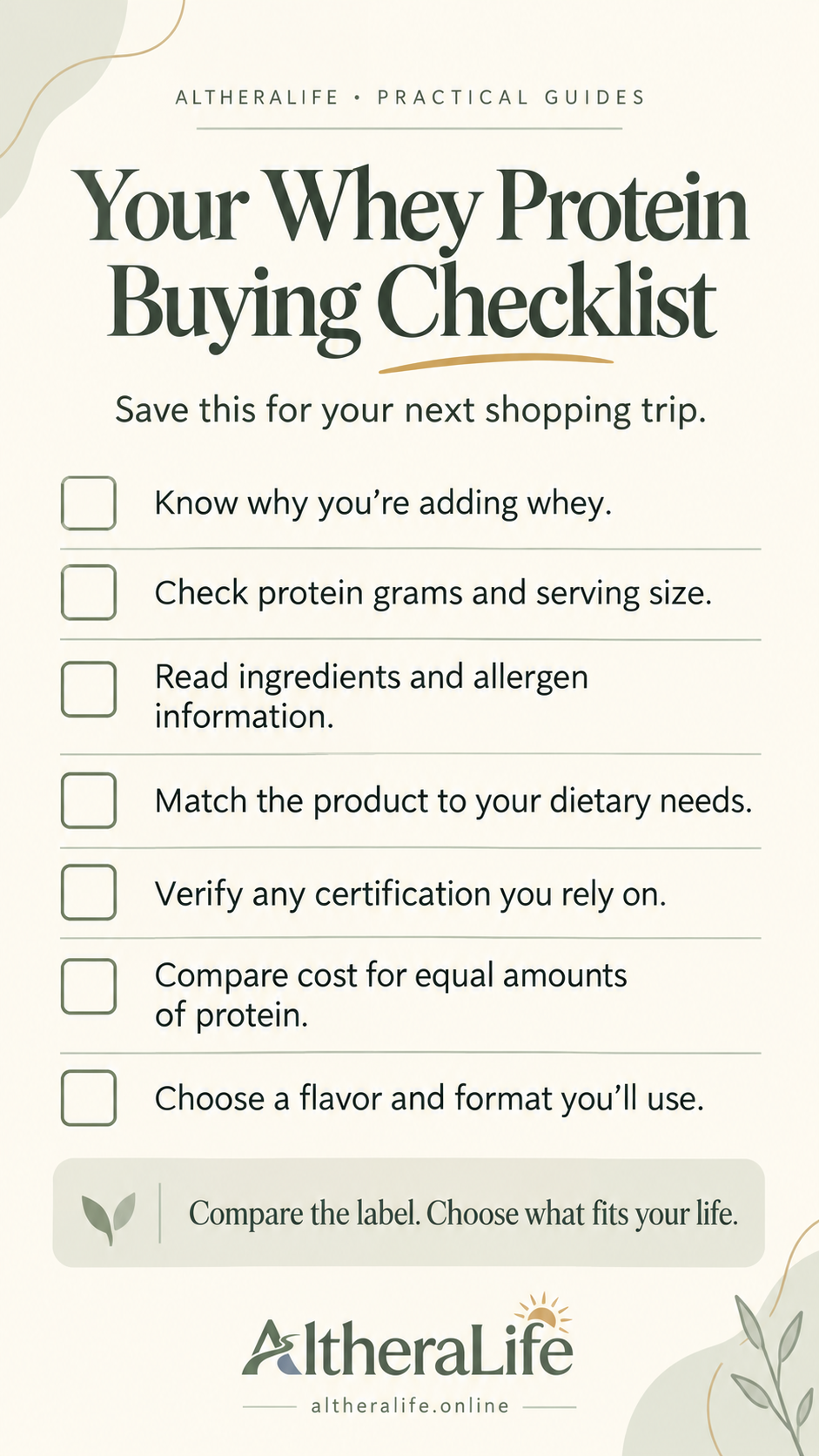
Your save-for-later buying checklist
- I know what role this powder would play in my meals.
- I checked the grams of protein and the serving size.
- I reviewed the full ingredients and allergen information.
- I checked whether the product fits my dietary restrictions.
- I verified any certification I am relying on.
- I compared the price for an equal amount of protein.
- I chose a flavor and format I can realistically use.
Save the checklist below so you know what to look for the next time you shop for whey protein.
Frequently asked questions
Do I need a special whey protein after 40?
Age alone is not a reason to choose a special formula. Start with your meals, health needs, activity, and preferences. Claims aimed at your age group still need the same careful evaluation as any other product claim.
Is isolate always the better choice?
Choose according to the finished product and your needs. Isolate generally has less lactose and fat than concentrate, but that difference does not decide every purchase. Compare ingredients, dietary suitability, and cost. [5]
Does a bigger scoop mean more protein?
Check the label. Scoop weight measures powder, while the protein line tells you how much protein the stated serving provides.
Should I automatically take one serving every day?
The package serving does not establish your personal supplement requirement. Harvard Health notes that protein needs depend on factors including activity, age, and health, and that many people can meet their needs through food. A registered dietitian can help you work out whether there is a gap to fill. [10]
Before you buy, put two labels side by side. Compare what matters to you, run the price calculation, and choose something that fits your life. You do not need to become a supplement expert to make a thoughtful choice.
This article provides general education and does not replace personalized medical or nutrition advice.
Sources and further reading
The pages below provide nutrition education; the research papers report scientific findings; the FDA explains regulation and labeling; NIDDK provides health information; and NSF describes its certification program. None is presented as endorsing a whey brand or Altheralife.
- Harvard T.H. Chan School of Public Health, The Nutrition Source. Protein.
- Morton RW, Murphy KT, McKellar SR, et al. A systematic review, meta-analysis and meta-regression of the effect of protein supplementation on resistance training-induced gains in muscle mass and strength in healthy adults. British Journal of Sports Medicine. 2018;52:376–384. PubMed record · DOI. The record also links to a published correction.
- National Institute of Diabetes and Digestive and Kidney Diseases (NIDDK). Healthy Eating for Adults with Chronic Kidney Disease.
- Harvard T.H. Chan School of Public Health, The Nutrition Source. Workout Supplements.
- Mignone LE, Wu T, Horowitz M, Rayner CK. Whey protein: The “whey” forward for treatment of type 2 diabetes? World Journal of Diabetes. 2015;6(14):1274–1284. Full text · PubMed record. Used here only for its description of whey processing and composition, not for a diabetes treatment recommendation.
- U.S. Food and Drug Administration. How to Understand and Use the Nutrition Facts Label.
- NIDDK. Definition & Facts for Lactose Intolerance.
- U.S. Food and Drug Administration. Questions and Answers on Dietary Supplements.
- NSF. What Our Mark Means · Certified Product Database.
- Gelsomin E. Harvard Health Publishing. The scoop on protein powder. March 9, 2020.
LET’S HEAR FROM YOU
Your issue.
Our next story.
What would you love to explore next? Suggest a topic, share an idea, or tell us what you’d like to see in our articles and videos.
Altheralife.
© 2025 Altheralife. All rights reserved.
Explore
Suporte
About Us
Contact
Editorial Policy
Newsletter
Legal & Privacy
Privacy Policy
Affiliate Disclosure
Terms of Use
Cookie Setting
Altheralife is operated by BIG ASS. E CONS. LTDA, CNPJ: 24.699.246/0001-61.