
More life in your life.
Living well after 40 involves everyday choices and knowing which ones deserve your attention.
Whey Isolate vs. Concentrate: Is the Extra Cost Worth It?
How to read two labels, compare what you’re getting, and decide what’s worth paying for.

You turn two tubs of whey around. Both say 24 grams of protein per serving. The isolate costs more, and the serving size is smaller. Is that a meaningful upgrade, or would you be just as happy with the concentrate?
The answer depends on what sent you to the supplement aisle in the first place. Maybe you want an easy way to add protein to breakfast. Maybe your usual shake leaves you uncomfortable. Or maybe you’re buying whey to support your strength training and wonder whether the pricier tub will do more for you.
The Quick Answer
Choose based on what the powder needs to do for you. If you tolerate concentrate and it delivers the protein you want at a better price, it’s a reasonable choice. Isolate is worth a closer look when you want more protein in less powder, or when the manufacturer can confirm a lower lactose content that matters to you. For muscle, the research below gives no clear reason to pay extra based on the word isolate alone. [1, 2, 4, 7]
What Actually Changes Between Concentrate and Isolate?
Both come from whey, a protein source derived from milk. To make isolate, manufacturers remove more of whey’s nonprotein components. The resulting ingredient generally contains a higher proportion of protein and less lactose and fat by weight. That difference can carry through to the finished powder, but a flavored product or a blend may have other ingredients that change the numbers. [1, 3]
Start with two lines on the back of the tub: serving size and protein per serving. The first tells you how much powder you’re using. The second tells you how much protein that amount provides. Two scoops can deliver identical amounts of protein while weighing different amounts. The lighter scoop may be handy if you stir the powder into a small bowl of yogurt. If you blend it into a full smoothie and like both products, you may care more about price and taste. [8, 9]
If Your Goal Is to Build or Keep Muscle
Imagine you’ve started lifting twice a week and want a breakfast that’s easier to put together on busy mornings. A powder that you enjoy and can work into a meal solves a practical problem. When both tubs provide the same amount of protein per serving, the isolate label tells you something about processing. It can’t tell you how much muscle you’ll gain.
A meta-analysis of 49 trials found that protein supplementation modestly improved gains in strength and lean mass during resistance training in healthy adults. A separate review focused on adults aged 60 and up with sarcopenia. It evaluated adding whey to resistance training and included studies using different forms of whey. Neither review establishes that isolate produces better long-term muscle gains than concentrate when protein intake is matched. Those studies answer questions about supplementation in the groups studied. Your shopping question is narrower. [4, 7]
If you’re shopping after 40, start by asking where the powder fits in a normal day. Would you use it in breakfast, after a workout, or on days when putting together a meal is difficult? Once you know what you want it for, you can compare the two products on the things that will actually affect your choice.
There’s a useful distinction here. Protein density tells you how much powder goes into a serving. It doesn’t measure how effective that serving will be over months of training. When the labels show equal protein per serving, decide whether the smaller scoop solves a problem you actually have. [4, 7–9]
If Concentrate Doesn’t Sit Well
If your usual shake bothers you, check the whole recipe before replacing the tub. What did you mix it with? Was it plain powder or a flavored blend? If you’re specifically trying to limit lactose, compare the powders and remember that regular milk in the shaker contributes lactose too. People with lactose intolerance can handle different amounts, so a product that suits one person may be a poor fit for another. [2, 6]
An isolate generally starts with less lactose than concentrate, but the word isolate on the front doesn’t tell you how much is in the finished product. Look for a product-specific lactose statement. If you can’t find one, ask the manufacturer how much lactose is in one serving of that exact flavor and formula. A Nutrition Facts line for total sugars gives you a combined number, rather than a separate lactose measurement. [1, 2, 8, 9]
What if you have a milk allergy? Lactose intolerance involves difficulty digesting milk sugar. A milk allergy is an immune reaction to milk proteins. Both whey concentrate and whey isolate contain milk protein and should be avoided if you have a milk allergy, including whey products labeled lactose-free. Check the ingredient and allergen statements. [5, 6]
Two Real Labels, Side by Side
Here’s how the comparison works with two unflavored powders from the same brand. These are label examples from the U.S. manufacturer’s listings, checked November 5, 2026. The prices are listed prices for the sizes shown, before taxes or shipping. [8, 9]
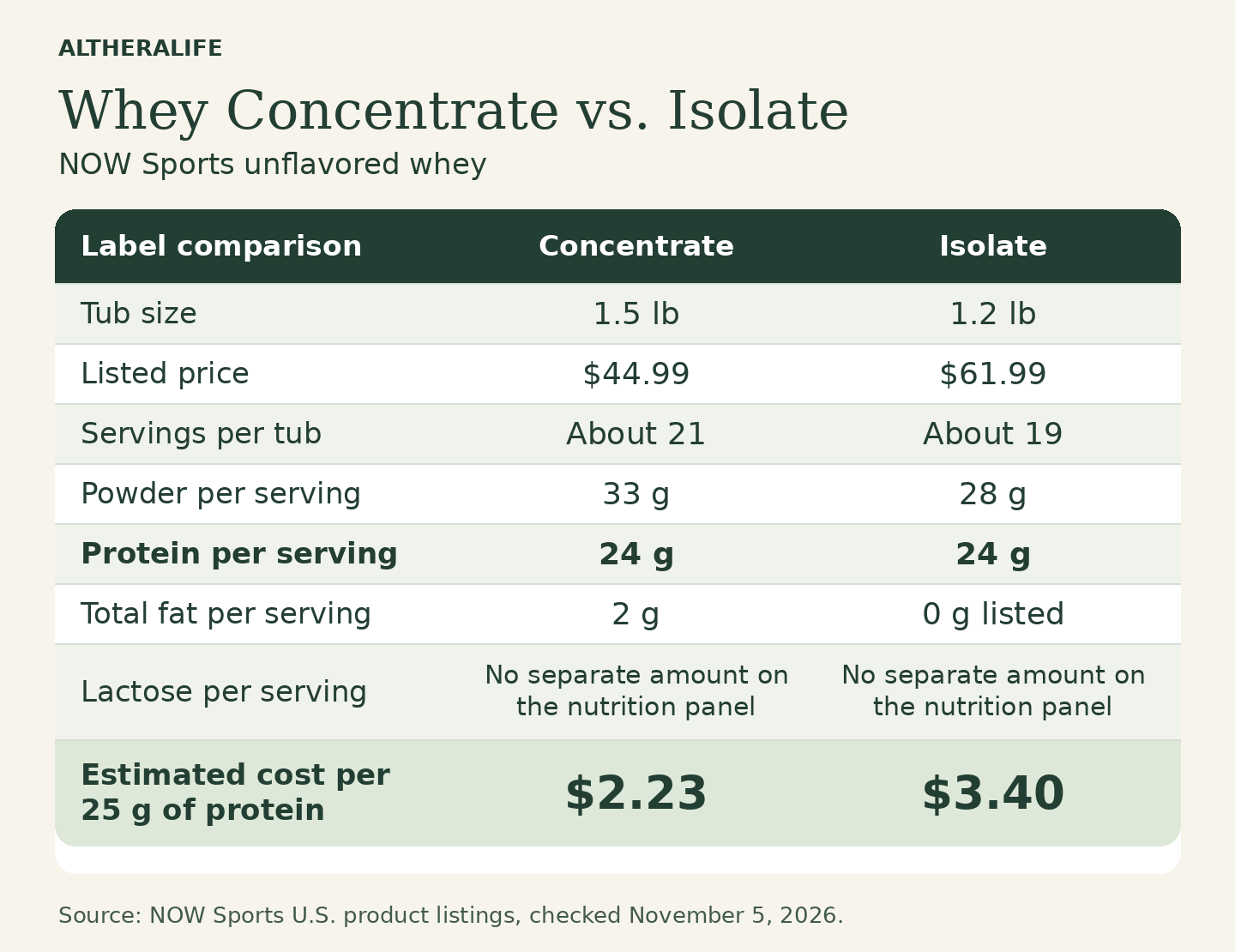
The isolate provides the same 24 grams of protein in 5 fewer grams of powder, and its panel lists less total fat. At these prices, it also costs about $1.17 more for an equal amount of protein. If you’re comparing these products mainly to reduce lactose, the two panels leave your most important question open. Ask about the lactose content before deciding whether that premium is worth paying. [8, 9]
How to Compare the Two Tubs in Front of You
You need three numbers: the price you’ll pay, the servings per tub, and the grams of protein per serving.
- Multiply servings per tub by grams of protein per serving to estimate the total protein in the package.
- Divide the price by that total to get the cost per gram.
- Multiply by 25 to make the result easier to compare.
For the concentrate above, that’s $44.99 ÷ (21 × 24) × 25, or about $2.23 per 25 grams of protein. The 25 grams are a comparison unit. Use the price you can actually get, especially if a sale or shipping fee changes the total. Since serving counts may be approximate, treat the result as an estimate. [8, 9]
One last question before buying a bigger tub: would you use all of it? A smaller package can make sense while you’re figuring out whether you like the flavor or how it mixes. Once you’ve found a powder you’ll use regularly, the price per equal amount of protein becomes more useful when comparing sizes.
The Bottom Line
If your current concentrate fits your routine, agrees with you, and gives you better value, you have a good reason to keep it. If you’re considering isolate, name the benefit you want and check whether that specific tub delivers it. The best comparison is the one that answers your own question, whether that’s how much powder goes into breakfast or how much lactose is in a serving.
Related reading: How to Choose a Whey Protein Powder After 40.
Sources
- Mignone LE et al. Whey protein: The “whey” forward for treatment of type 2 diabetes? World Journal of Diabetes. 2015. See the section on whey protein forms.
- NIDDK. Eating, Diet, & Nutrition for Lactose Intolerance.
- Harvard T.H. Chan School of Public Health. Workout Supplements.
- Morton RW et al. Protein supplementation and resistance training: systematic review and meta-analysis. British Journal of Sports Medicine. 2018.
- FDA. Questions and Answers Regarding Food Allergens and Labeling Requirements. See Figure 6 for a whey isolate label example.
- NIDDK. Symptoms & Causes of Lactose Intolerance.
- Cuyul-Vásquez I et al. Whey protein supplementation and resistance training in older adults with sarcopenia: systematic review and meta-analysis. Nutrients. 2023.
- NOW Sports. Whey Protein Concentrate, Unflavored Powder. Manufacturer label and price listing, accessed November 5, 2026.
- NOW Sports. Whey Protein Isolate, Unflavored Powder. Manufacturer label and price listing, accessed November 5, 2026.
LET’S HEAR FROM YOU
Your issue.
Our next story.
What would you love to explore next? Suggest a topic, share an idea, or tell us what you’d like to see in our articles and videos.
Altheralife.
© 2025 Altheralife. All rights reserved.
Explore
Suporte
About Us
Contact
Editorial Policy
Newsletter
Legal & Privacy
Privacy Policy
Affiliate Disclosure
Terms of Use
Cookie Setting
Altheralife is operated by BIG ASS. E CONS. LTDA, CNPJ: 24.699.246/0001-61.